
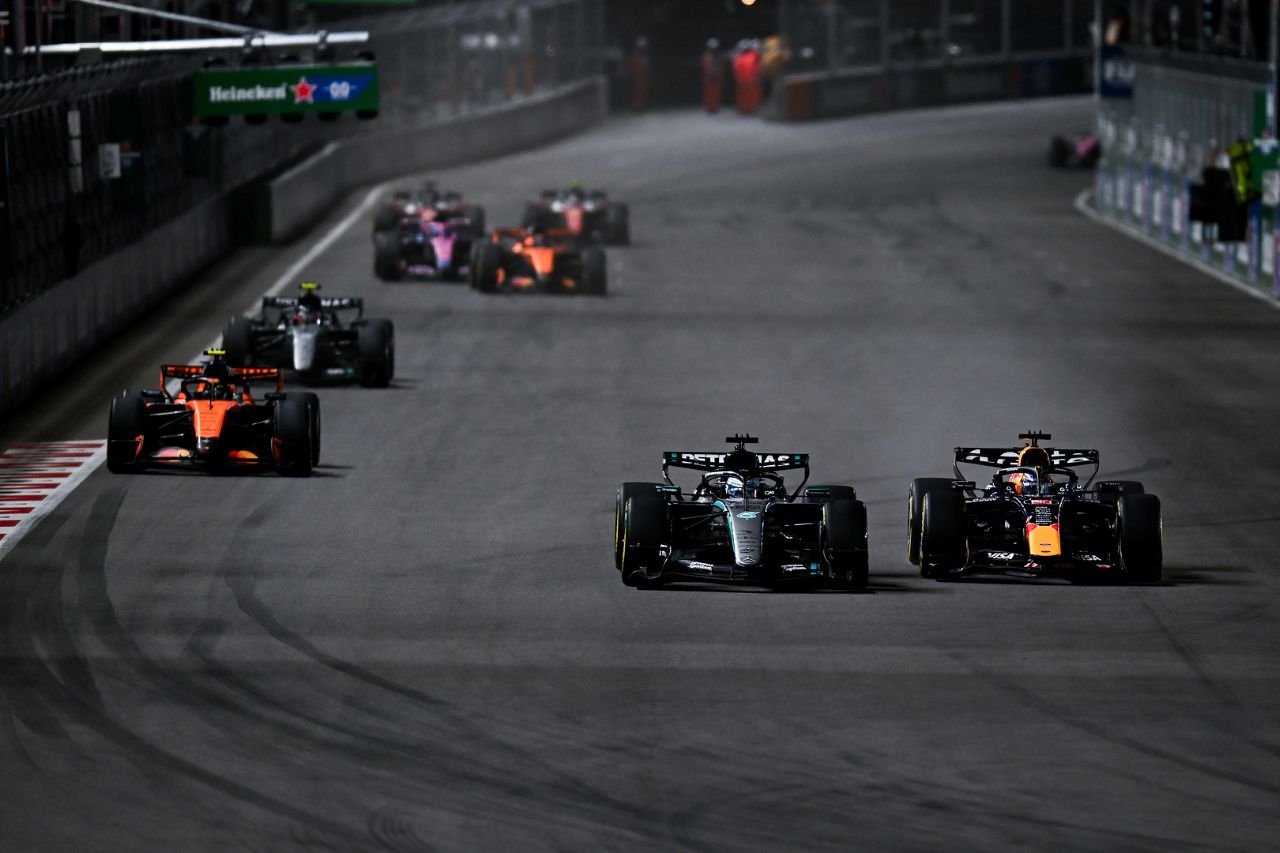
Yo-yo racing is good racing, but only when the driver still decides the result. Las Vegas showed it at its best.
In 30 seconds
- In Las Vegas, the lead changed constantly, and the drivers still had to think about where to deploy, how to work with their engineers and where to make the move.
- It breaks down when the format decides the race: the extreme yo-yo we saw in China, or a battery that punishes the natural move, as it did to Kimi Antonelli.
- The tow was worth about six tenths of a second a lap, so the leader could not escape. The longer the queue chasing the leader, the larger the tow effect.
What is yo-yo racing?
As I said in our Las Vegas review on the Inside Line F1 Podcast: let’s not kid ourselves, Las Vegas was yo-yo racing. The batteries run down, and the overtake mode (the extra electrical power a driver can use to attack) hands the chasing car a big advantage. The car in front gets passed, uses its own overtake mode to pass back, and the lead changes hands again and again.
Fans see an exciting race, and engineers see a power unit rule at work. The question is whether the excitement comes from the drivers or from the battery.
Why Las Vegas worked
In Las Vegas, the answer was the drivers. The batteries ran down and the lead changed constantly, but what made it special is that the drivers still had to think. Where do you deploy? How do you work with your engineers on strategy? Where is the best place to make the move?
There were 352 overtakes in the race, spread across the circuit. Max Verstappen, Kimi Antonelli and George Russell were never just passengers.
Max is the best example. He was challenged by Russell, Antonelli, Lando Norris, Isack Hadjar and, in parts, Oscar Piastri. At his lowest he was second, and if my reading is right he never fell to third. He read the race around lap 40, changed his approach from lap 42 and used the tow better than anyone.
Then came the photo finishes. Max and Antonelli kept giving us one after the other, each rehearsing for the final lap. That is not a lottery. That is two drivers planning how to win it.
Even if you set the battery aside, the driver still mattered. One driver has the better drive off the final corner, another is better into turn one, a third goes around the outside of turns two and three. That is exactly what we want to see. When I commentate on these races for Viaplay and FanCode, it is what I look for: decisions the viewer can see and understand.
Where it breaks
Two things worry me.
- When it goes to the extreme. Las Vegas was unlike the extreme yo-yo we saw in the Chinese Grand Prix. There is a line, and once the battery decides who is ahead, the driver is a spectator.
- When the battery punishes the natural move. On the final lap, Antonelli lifted off the throttle to get overtake mode, the battery got confused and he fell from the fight for the win to fourth. That is a driver being punished for acting on instinct.
So is it good racing?
My verdict has two parts.
The race: 11 out of 10. I loved it, and I would watch it again tomorrow.
The format: it passes the test when skill still decides the result. In Vegas, it did. The drivers chose where to deploy, planned their final laps and made their moves.
But the test is not the excitement. Excitement is easy to produce with a battery. The test is whether a driver who does everything right is rewarded, and whether a driver who does something natural is not punished by software. By that test, one great race is not enough proof.
That is the challenge of the 2026 power units: keep the racing as good as Las Vegas, without letting the battery take the decision out of the drivers’ hands. Maybe, this is why Lando Norris said that the 2030 Las Vegas Grand Prix, with the new V8 engines, will be even more entertaining!
If Las Vegas is the standard, will we get a race like it every week, or only when the track and conditions line up? The answer, to that question, is obvious.
Kunal Shah is a multilingual Formula 1 broadcaster with Viaplay in Norway and FanCode in India, both official F1 broadcasters, and an FIA-accredited journalist. He co-hosts the award-winning Inside Line F1 Podcast with Soumil Arora and works with junior drivers. Previously, he led marketing, sponsorship and the junior driver programme at the Force India F1 Team.


